
01 · Compliance & ESG: Governance That Builds Trust
Oceyon’s work begins with authorisation and continues with transparent cooperation.
At sea, Oceyon locates and surveys historic shipwrecks and recovers their cargo, under authorisation from the state responsible for each site.
On land, Oceyon locates and surveys deposits concealed or buried in the past, and recovers them with the consent of the landowner and under the heritage law of the country concerned.
Oceyon AG is a Swiss commercial company that locates, documents and recovers lost historic value: the cargo of shipwrecks at sea, and deposits concealed or buried and never recovered, on land. Its programmes are privately financed and begin only with the authorisation of the state, authority or landowner responsible, under agreements that set out in advance how title is determined and value is shared. Every find is recorded, conserved and accounted for.
No fieldwork without a signed authorisation.
Every site is understood before anything is moved.
Recorded, conserved and reported to the authority concerned.
Three phases, in the same order every time. Restoration begins with compliance.
Oceyon’s site selection is founded on a private maritime research archive, to which Oceyon holds exclusive access.
Research and legal analysis. A signed agreement with the state before any survey.
Survey without contact. Recovery only under licence.
Every find recorded and conserved. Disposition agreed with the host state.
On land, site selection rests on satellite image analysis.
Satellite analysis and legal review. A signed landowner agreement before any fieldwork.
Non-invasive survey first. Excavation only where authorised.
Every find recorded and conserved. Disposition agreed with the landowner and the authority.
Oceyon’s DNA is its operational compass: a code of conduct that defines how Oceyon works, whom it works with, and what it refuses to do. It joins the discipline of field operations with respect for science, heritage and the environment.
What Oceyon refuses to do
Every programme, at sea and on land, rests on the same four disciplines. Together they make recovery lawful, precise and respectful of the places we work in.
Objects of significance conserved, documented and available to national institutions.
Survey data, archival research and site records shared with the authority.
Joint work and training with local archaeologists, conservators and crews.
How title vests and how value is apportioned are agreed before any work begins.
Cargo and deposits lost for centuries, owned by the state throughout, become recoverable, and the value returns under the agreement.
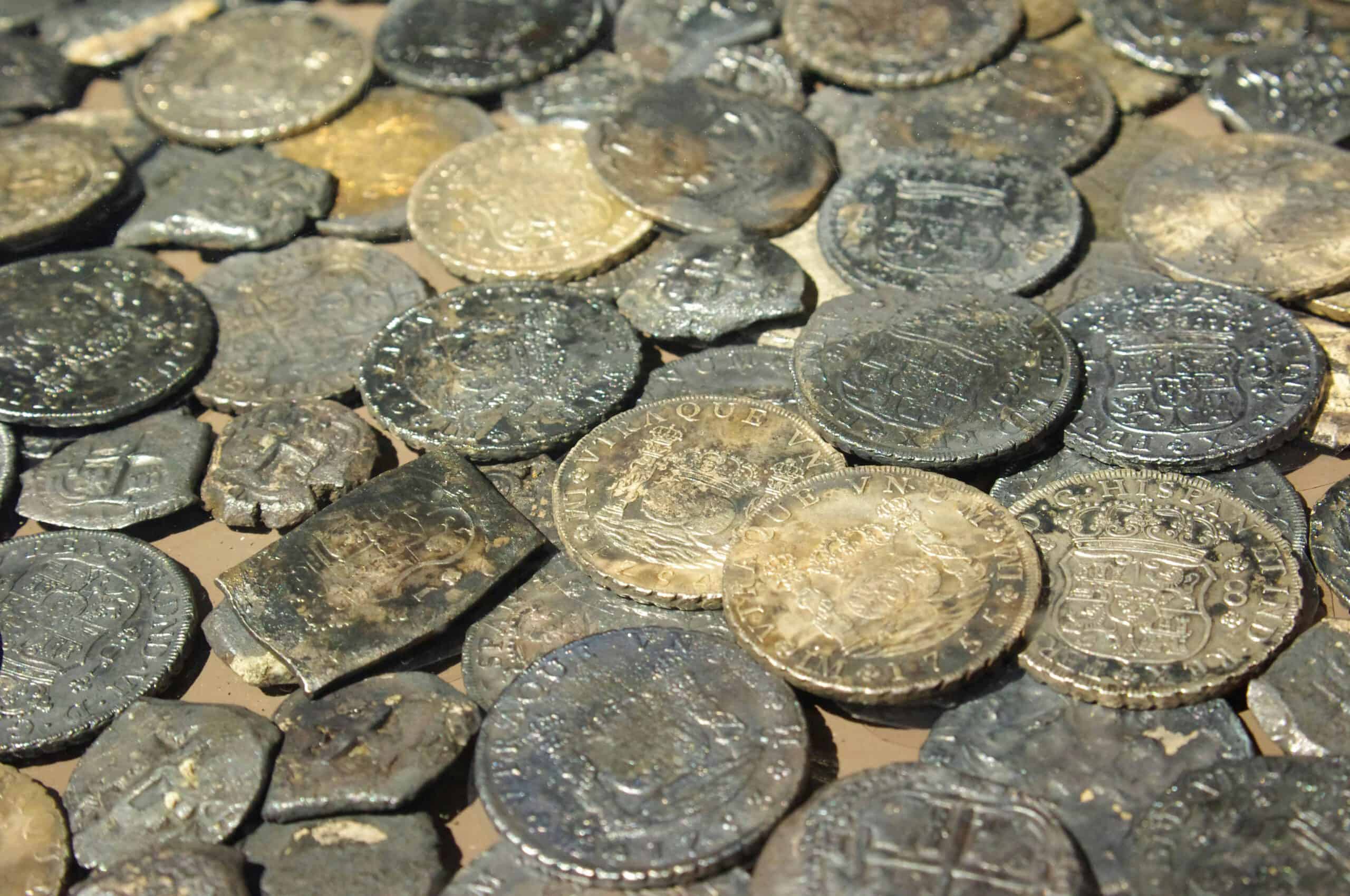
Antique gold and silver coins. Musée de l’Ephèbe et d’archéologie sous-marine, Avenue des Hallebardes, France.
Photo: Neutron on Unsplash.
Oceyon AG is a Swiss company, domiciled in Zug, that locates, documents and recovers lost historic value in two fields: the cargo of historic shipwrecks at sea, and deposits concealed or buried and never recovered, on land. It works only under authorisation from the state, authority or landowner responsible, and every programme follows the same three phases: Research & Comply, Verify & Recover, and Secure & Conserve.
Yes. Its programmes are privately financed and carried out under agreements with the state, authority or landowner concerned. Those agreements set out, before any work begins, how title is determined and how value is shared. Material of historical or cultural significance is conserved. Metal that carries no archaeological evidence may be refined, by agreement with the host state.
Yes. Oceyon works in two fields. At sea, it locates historic shipwrecks and recovers their cargo. On land, it locates deposits concealed or buried and never recovered, and works only with the consent of the landowner and under national heritage law.
Oceyon does not work on war graves or on protected heritage sites, and in a protected marine area it does no work without the express authorisation of the body responsible for it. It does not carry out seabed mining. It does not work on land without the landowner’s consent, and it does no fieldwork anywhere without a signed authorisation.
Ministries, heritage authorities, research institutions, museums and landowners: every institutional enquiry is answered personally.
Oceyon is privately held and financed by its shareholders. Nothing on this website constitutes an offer, a solicitation or an invitation to invest. Enquiries from prospective investors are handled individually.


Hosted in Switzerland by cyon, Basel, in a data centre run on renewable electricity.
